
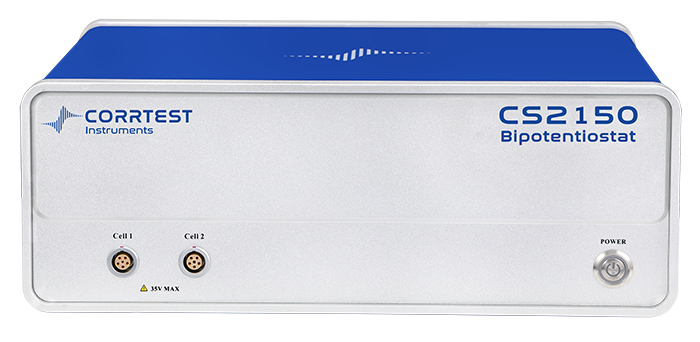
Description
Application
(1) Electrosynthesis, electrodeposition (electroplating), anodic oxidation, electrolysis
(2) Oxygen reduction reaction (ORR), oxygen evolution reaction (OER), Hydrogen evolution reaction (HER), carbon dioxide reduction.
(3) Energy and materials (Li-ion battery, solar cell, fuel cell, supercapacitor), advanced function materials, and sensor.
(4) Corrosion behavior of metals, and anti-corrosion evaluation
(5) Fast evaluation of inhibitor, water quality stabilizer, coating, and cathodic protection efficiency.
Standard supply
Instrument CS2350M x1
CS studio software x1
Power cable x1
Ethernet cable x1
Cell cable x 4
Dummy cell (1kΩ||100µF) x2
Typical applications
Rotating ring-disk electrode (RRDE)
Oxidation/reduction reaction (ORR) study: while measuring the polarization curve of disk electrode in the main channel, apply a constant polarization potential on the ring electrode, and thus detect the intermediate products on the disk electrode. RRDE test becomes the typical method for ORR study. CS2350M can be connected to any RRDE equipment.
.png)
.png)
Hydrogen diffusion test (HDT)
CS2350M bipotentiostat is combined with H-cells. By measuring current of cathode hydrogen charging and hydrogen atoms anode oxidation, it can further calculate the diffusion coefficient of hydrogen atoms in metal and hydrogen flux.
.png)
.jpg)
Technical advantages
1. Impedance (EIS)
Corrtest potentiostat applies correlation integral algorithm and dual-channel over-sampling technique, and has strong anti-interference ability. It is suitable for EIS measurements of high-impedance system (>109Ω, such as coating, concrete etc.).
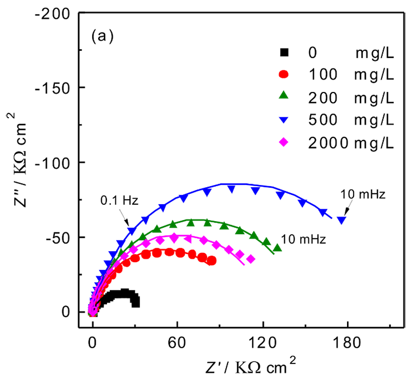
EIS of AA6063 Al alloy in Ce3+ containing 3% NaCl solution
- Polarization curve
Tafel plot can be obtained. The user can set the anodic reversal current (passivation film breakdown current) of the cyclic polarization curve to obtain material’s pitting potential and protection potential and uate the its susceptibility to intergranular corrosion. The software uses non-linear fitting to analyze polarization curve, and can make fast evaluation of material’s anti-corrosion ability and inhibitors.
.png)
Polarization curve of Ti-based amorphous alloy & stainless steel in 3%NaCl solution
- Voltammetry
Linear Sweep Voltammetry(LSV), Cyclic Voltammetry(CV), SCV, SWV, DPV, NPV,ACV, Stripping voltammetry etc. It integrates calculation of peak area, peak current and standard curve analysis.
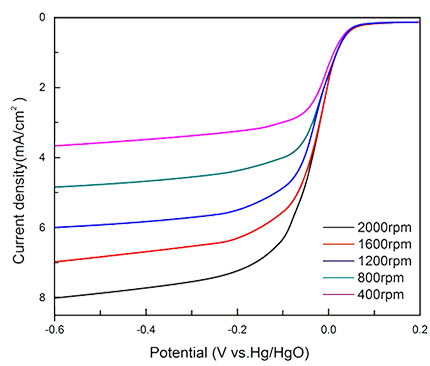
LSV: mesoporous carbon material in 0.1M KOH
.jpg)
CV of PPy supercapacitor in 0.5 mol/L H2SO4
- Electrochemical Noise
With high-resistance follower and zero-resistance ammeter, it measures the natural potential/current fluctuations in corrosion system. It can be used to study pitting corrosion, galvanic corrosion, crevice corrosion, and stress corrosion cracking etc. Based on calculation of noise resistance and pitting index, it can complete localized corrosion monitoring.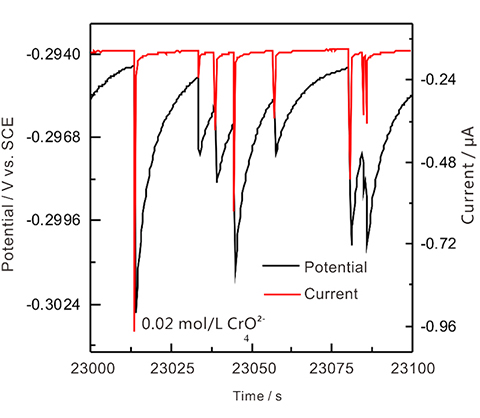
- Full floating measurement
Full-floating mode be used for autoclave electrochemical measurements, on-line corrosion monitoring of metallic components under the ground (rebar in concrete, etc.) - Software development kit(SDK)
We are able to provide API functions and development examples, which facilitates some users’ requirements for secondary development and self-defined measurements. We can provide .dll file.
Software Features
Cyclic voltammetry:
CS studio software provides users a versatile smoothing/differential/ integration kit, which can complete the calculation of peak height, peak area and peak potential of CV curves. In CV technique, during the data analysis, there is function of selecting exact cycle(s) to show. You can choose to see a cycle or some cycles as you want. You can also export data or vector graph of an exact cycle or several cycles..png)
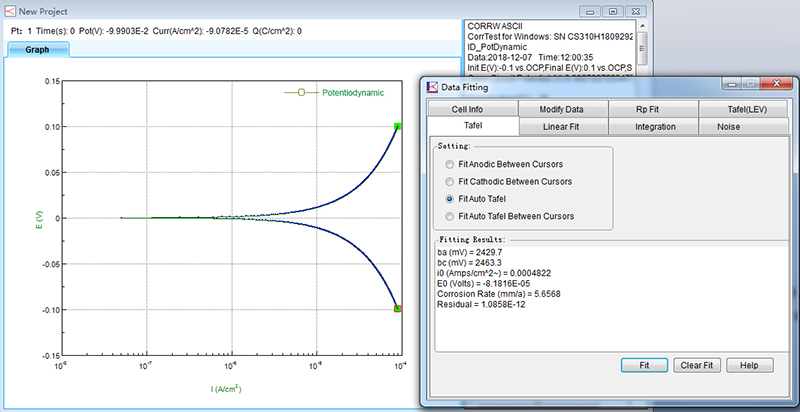
Tafel plot and corrosion rate:
CS studio also provides powerful non-linear fitting on Butler-Volmer equation of polarization curve. It can calculate Tafel slope, corrosion current density, limitation current, polarization resistance, corrosion rate. It can also calculate the power spectrum density, noise resistance and noise spectrum resistance based on the electrochemical noise measurements.
Battery Test and analysis:
charge & discharge efficiency, capacity, specific capacitance, charge & discharge energy.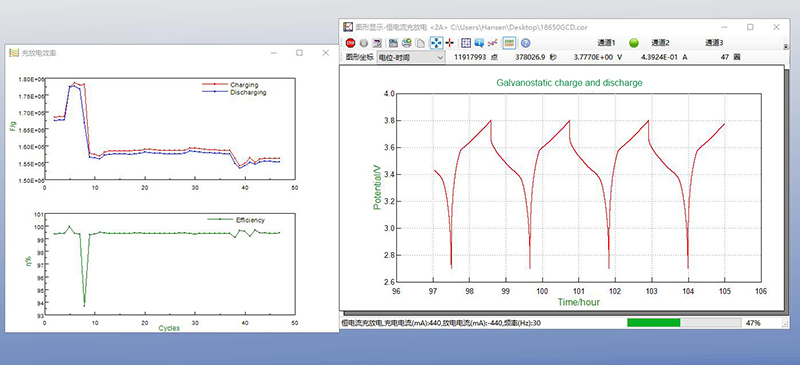
EIS analysis: Bode, Nyquist, Mott-Schottky plot
During EIS data analysis, there is built-in fitting function to draw the custom equivalent circuit.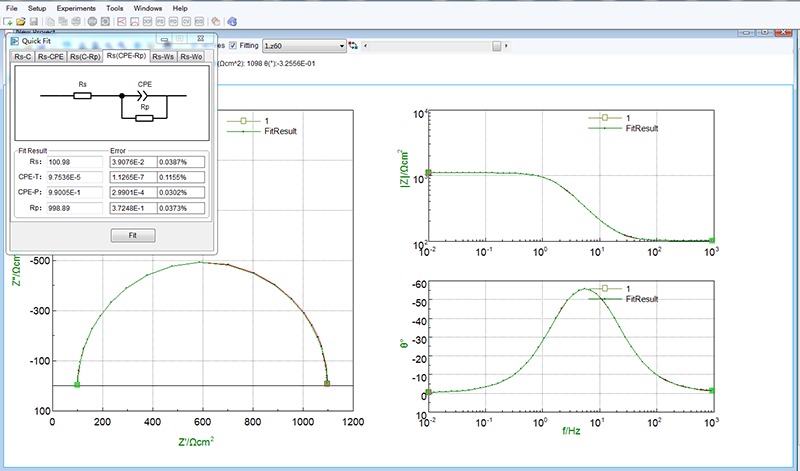
Real time saving of data: The data can be automatically saved even in case of sudden power off.
Combination test: it can facilitate the automation of experiments and save time. With the unique function of combination test, you can choose several techniques, and set the wait time, the start time, and the cycles. Choose the experiments you want to run. Then you can make auto measurement of the set experiments as you want without having to wait in the lab. This function is especially useful if you have multi experiments to run and save your time greatly.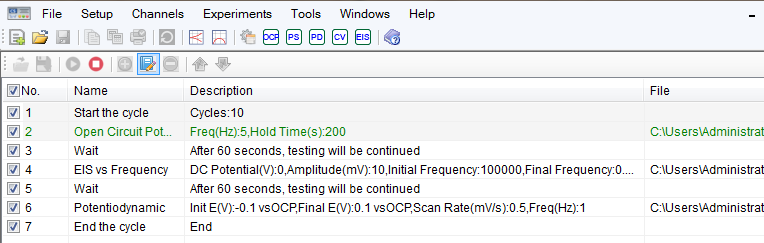
Data open: You can open the data files by txt format in notepad. Data can also be opened in Origin
Specifications
| Specifications | |
| Support 2-, 3- or 4-electrode system | Interface: Ethernet |
| Potential control range: Primary Channel: ±10V second Channel: ±10V | Current control range: ±1A for each channel |
| Potential control accuracy: 0.1%×full range±1mV | Current control accuracy: 0.1%×full range |
| Potential resolution: 10μV (>100Hz), 3μV (<10Hz) | Current sensitivity:1pA |
| Rise time: <1μS (<10mA), <10μS (<2A) | Reference electrode input impedance: 1012Ω||20pF |
| Current range: 2nA~2A, 10 ranges | Compliance voltage: ±21V |
| Maximum current output: ±1A for each channel | CV and LSV scan rate: 0.001mV~10,000V/s |
| CA and CC pulse width: 0.0001~65,000s | Current increment during scan: 1mA@1A/ms |
| Potential increment during scan: 0.076mV@1V/ms | SWV frequency: 0.001~100 kHz |
| DPV and NPV pulse width: 0.0001~1000s | AD data acquisition:16bit@1 MHz,20bit@1 kHz |
| DA Resolution:16bit, setup time:1μs | Minimum potential increment in CV: 0.075mV |
| IMP frequency: 10μHz~1MHz | Low-pass filters: Covering 8-decade |
| Potential and current range: Automatic | Weight / Measurements: 8kg,36.5 x 30.5 x16cm |
| Operating System: Windows 10/11 | |
| Electrochemical Impedance Spectroscopy (EIS)* (Only CS2350) | |
| Signal generator | |
| Frequency range:10μHz~1MHz | AC amplitude:1mV~2500mV |
| DC Bias:-10~+10V | Output impedance:50Ω |
| Waveform: sine wave, triangular wave and square wave | Wave distortion:<1% |
| Scanning mode: logarithmic/linear, increase/decrease | |
| Signal analyzer | |
| Integral time:minimum: 10ms or the longest time of a cycle |
Maximum:106 cycles or 105s |
| Measurement delay:0~105s | |
| DC offset compensation | |
| Potential auto compensation range: -10V~+10V | Current compensation range: -1A~+1A |
| Bandwidth: 8-decade frequency range, automatic and manual setting | |
Techniques
Techniques/Methods in each channel – CS2350M
Stable polarization
- Open Circuit Potential (OCP)
- Potentiostatic (I-T curve)
- Galvanostatic
- Potentiodynamic (Tafel plot)
- Galvanodynamic (DGP)
- Sweep-Step Functions (SSF)
Transient Polarization
- Multi Potential Steps
- Multi Current Steps
- Potential Stair-Step (VSTEP)
- Galvanic Stair-Step (ISTEP)
Chrono Method
- Chronopotentiometry (CP)
- Chronoamperametry (CA)
- Chronocaulometry (CC)
Voltammetry
- Linear Sweep Voltammetry (LSV)
- Cylic Voltammetry (CV)
- Staircase Voltammetry (SCV)
- Square Wave Voltammetry (SWV)
- Differential Pulse Voltammetry (DPV)
- Normal Pulse Voltammetry (NPV)#
- Differential Normal Pulse Voltammetry (DNPV)
- AC Voltammetry (ACV)
- 2nd harmonic AC Voltammetry (SHACV)
- Fourier Transform AC Voltammetry (FTACV)
Amperometric
- Differential Pulse Amperometry (DPA)
- Double Differential Pulse Amperometry (DDPA)
- Triple Pulse Amperometry (TPA)
- Integrated Pulse Amperometric Detection (IPAD)
Stripping Voltammetry
- Potentiostatic Stripping
- Linear Stripping
- Staircase Stripping
- Square Wave Stripping
- Differential Pulse Voltammetry Stripping
- Normal Pulse Voltammetry Stripping
- Differential Normal Pulse Voltammetry Stripping
Electrochemical Impedance Spectroscopy (EIS)* (Only CS2350)
- EIS vs Frequency (IMP)
- Galvanostatic EIS
- EIS vs Potential (IMPE)(Mott-Schottky)
- EIS vs Time (IMPT)
- Galvanostatic EIS vs Time
Corrosion Measurements
- Cyclic polarization curve (CPP)
- Linear polarization curve (LPR)
- Electrochemical Potentiokinetic Reactivation (EPR)
- Electrochemical Noise (EN)
- Zero resistance Ammeter (ZRA)
Battery test
- Battery Charge and Discharge
- Galvanostatic Charge and Discharge (GCD)
- Potentiostatic Charging and Discharging
- Potentiostatic Intermittent Titration Technique
- Galvanostatic Intermittent Titration Technique
Extensions
- Data Logger
- Electrochemical Stripping/ Deposition
- Bulk Eletrolysis with Coulometry (BE)
- Rs Measurement


