
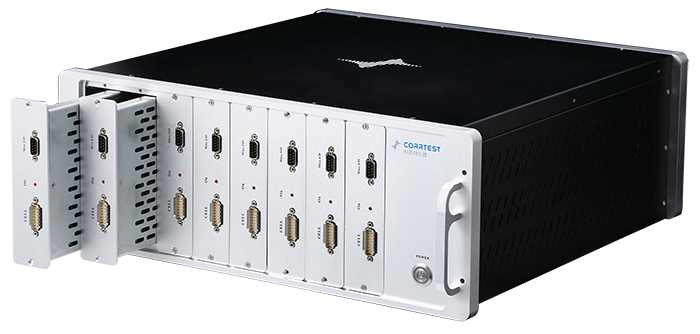
Description
Option A and Option B configurations have 4 channels. The chassis comes with 4 empty slots where you can add a new card in the future. (Option C) and (Option D) come with 8 channels filled.
Option A and C only have EIS on the main channels. Options B and D have EIS on all channels.
EIS module (10μHz~1MHz) is equipped one channel. Each channel potential control range is ±10V, current control range ±1A, can meet experiment requirement for most people.
Full floating module and electrical isolation design guarantee each channel is totally independent, which ensures accurate data and efficient simultaneous measurements.
Multichannel potentiostat brings convenience to those who have many samples, and is an ideal device for studies of energy materials, battery study, metal corrosion etc.
Advantages
High Current/Voltage: Applied potential range ±10V, current range ±1A. It can meet the needs of most studies.
Comprehensive techniques: Internal EIS (10μHz~1MHz) is equipped in at least one channel. Each channel has comprehensive techniques.
Warranty: 2 years warranty. Our engineers will provide technical support at any time you need.
Low cost: The price includes the instrument body, software (experiment control and data processing), necessary cables and Dummy Cell. You do not pay any other fees. (Electrodes and cells are not included.)
Reliability and quality: The manufacturer has been producing for 20 years and is the No. 1 brand of these products in its region.
Application
– Reaction mechanism of Electrosynthesis, electrodeposition (electroplating), anodic oxidation.
– Electrochemical analysis, electro-catalysis, sensor;
– New energy materials, advanced functional materials, photoelectronic materials;
– Corrosion study of metals in water, concrete and soil etc;
– Fast evaluation of corrosion inhibitor, water stabilizer, coating and cathodic protection efficiency.
Simultaneous Measurements
The customer can choose a same electrochemical technique in every channel. For example, among 8 channels, you can choose to run 4 channels to all do EIS measurement. Set the parameters just one time, then EIS measurement in each channel will be conducted at the same time.(Here is an example of using the 4 channels. You can run the 8 experiments at the same time on one window)
In each channel, you can also conduct different experiments.As is shown in the below picture, EIS, galvanostatic charge and discharge, CV, and polarization curve tests are conducted at the same time.(Here is an example of using the 4 channels. You can run the 8 experiments at the same time on one window)
Standard supply for Multichannel Devices:
Instrument Host *1
CSStudio software package *1
Power cable * 1,
Ethernet cable *1
Cell/Electrode cable *16 PCS (2pcs for each channel)
Dummy cell *8 PCS (1pc for each channel)
After-sales Service (All the service is totally FREE)
1. Warranty period: 2 years.
2. Provide manual, software installation video & training videos.
3. Free repair service
4. Lifetime software upgrading (same model) and technical service.
| Specifications | |
| Number of channels: 4 or 8 | Channel insulation resistance: >100MΩ |
| Communication: Ethernet | Lower-pass filter: covering 8-decade |
| Potential control range: ±10V | Constant current control range: ±1A |
| Potential accuracy: 0.1%×full range±1mV | Current accuracy: 0.1%×full range |
| Potential resolution:10μV(>100Hz), 3μV(<10Hz) | Current resolution: 1pA |
| Potential rise time: ﹤1μs(<10mA),<10μs(<2A) | Current range: 2nA ~1A |
| Reference electrode input impedance: 1012Ω||20pF | Maximum current output: ± 1A |
| Compliance: ±12V | Current increment during scan: 1mA @1A/ms |
| CV and LSV scan rate: 0.001mV~10000V/s | Potential increment during scan: 0.076mV@1V/ms |
| CA and CC pulse width: 0.0001~65000s | DPV and NPV pulse width: 0.0001~1000s |
| SWV frequency:0.001~100KHz | CV minimum potential increment: 0.075mV |
| AD data acquisition: 16bit@1MHz,20bit @1kHz | IMP frequency:10μHz~1MHz |
| DA resolution:16bit, setup time:1μs | Current and potential range: automatic |
| Operating System requirements: Windows 10/11 |
Weight: 12Kg |
| Electrochemical Impedance Spectroscopy(EIS) | |
| Signal generator | |
| Frequency range:10μHz~1MHz | AC signal amplitude: 1mV~2500mV |
| Frequency accuracy:0.005% | Signal resolution: 0.1mV RMS |
| DDS output impedance: 50Ω | DC Bias: -10V~+10V |
| Wave distortion: <1% | Waveform: sine wave, triangular wave, square wave |
| Scan mode: Logarithmic/linear, increase/decrease | |
| Signal analyzer | |
| Maximum integral time:106 cycles or 105s | Measurement delay:0~105S |
| Minimum integral time:10ms or the longest time of a cycle | |
| DC offset compensation | |
| Potential compensation range: -10V~+10V | Current compensation range: -1A~+1A |
| Bandwidth adjustment: automatic and manual, 8-decade frequency range | |
Techniques
Techniques in each channel – CS310X Option C
(EIS is included in One channel)
Stable polarization
- Open Circuit Potential (OCP)
- Potentiostatic (I-T curve)
- Galvanostatic
- Potentiodynamic (Tafel plot)
- Galvanodynamic (DGP)
Transient Polarization
- Multi Potential Steps
- Multi Current Steps
- Potential Stair-Step (VSTEP)
- Galvanic Stair-Step (ISTEP)
Chrono Method
- Chronopotentiometry (CP)
- Chronoamperametry (CA)
- Chronocaulometry (CC)
Voltammetry
- Linear Sweep Voltammetry (LSV)
- Cylic Voltammetry (CV)
- Staircase Voltammetry (SCV)
- Square Wave Voltammetry (SWV)
- Differential Pulse Voltammetry (DPV)
- Normal Pulse Voltammetry (NPV)#
- Differential Normal Pulse Voltammetry (DNPV)
- AC Voltammetry (ACV)
- 2nd harmonic AC Voltammetry (SHACV)
- Fourier Transform AC Voltammetry (FTACV)
Stripping Voltammetry
- Potentiostatic Stripping
- Linear Stripping
- Staircase Stripping
- Square Wave Stripping
- Differential Pulse Voltammetry Stripping
- Normal Pulse Voltammetry Stripping
- Differential Normal Pulse Voltammetry Stripping
Amperometric
- Differential Pulse Amperometry (DPA)
- Double Differential Pulse Amperometry (DDPA)
- Triple Pulse Amperometry (TPA)
- Integrated Pulse Amperometric Detection (IPAD)
Electrochemical Impedance Spectroscopy (EIS)
- EIS vs Frequency (IMP)
- Galvanostatic EIS
- EIS vs Potential (IMPE)(Mott-Schottky)
- EIS vs Time (IMPT)
- Galvanostatic EIS vs Time
Corrosion Measurements
- Cyclic polarization curve (CPP)
- Linear polarization curve (LPR)
- Electrochemical Potentiokinetic Reactivation (EPR)
- Electrochemical Noise (EN)
- Zero resistance Ammeter (ZRA)
Battery test
- Battery Charge and Discharge
- Galvanostatic Charge and Discharge (GCD)
- Potentiostatic Charging and Discharging(PCD)
- Potentiostatic Intermittent Titration Technique (PITT)
- Galvanostatic Intermittent Titration Technique (GITT)
Extensions
- Electrochemical Stripping/ Deposition
- Bulk Eletrolysis with Coulometry (BE)
- Rs Measurement


