
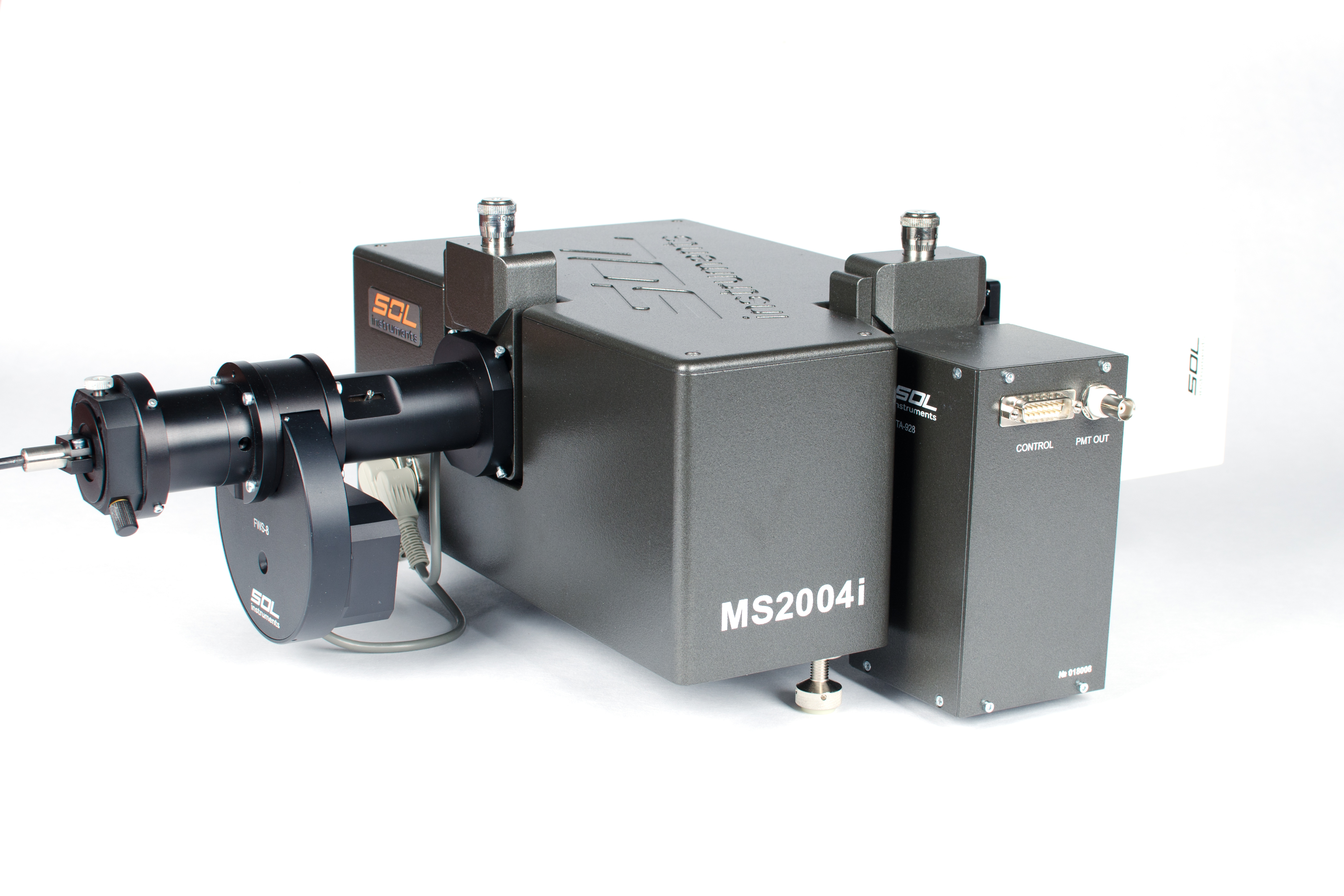
Description
| MS200 Series monochromator-spectrographs are based on Cherny–Turner asymmetric scheme that allows to minimize of aberrations and exclude spectra re-entrance from diffraction gratings and mirrors.
High-quality optics and wide choice of diffraction gratings provide devices operation in a wide range from 185 nm up to 60 µm (depending on the selected grating). Model MS2001i and model MS2004i have the astigmatism-correctedoptics what makes these devices applicable in multi-channel spectroscopy.
A single-position holder for easy manual switching of gratings is used in both models MS2001 and MS2001i. A wide choice of changeable gratings gives the best combination of high energetic efficiency and maximal spectral resolution for different spectrum areas. Automated four-grating turret (model MS2004 and model MS2004i) provides a fast switching of gratings with high repeatability of the set wavelength. Monochromators–spectrographs of MS200 series have one input port and two output ports. Selection of an output port is realized with an automated mirror. Either output spectral slits or multi-channel detectors can be installed on each of the output ports. We offer monochromators–spectrographs of MS200 Series with two types of input and output spectral slits: manual, operated with a micrometer screw and automated (combined) when the slit width is operated automatically or manually (with micrometer). Compactness in combination with technical characteristics make monochromators–spectrographs of MS200 Series ideal for OEM applications in customized spectroscopy systems.
|
|


Models of monochromators–spectrographs of MS200 series
| MS2001 | MS2001i | MS2004 | MS2004i | |
| Diffraction unit | Single-position holder for manually changeable gratings | Single-position holder for manually changeable gratings | Four–grating turret | Four–grating turret |
| Optics | Standard | Astigmatism–compensated | Standard | Astigmatism–compensated |
| In the devices with the standard optics (model MS2001 and model MS2004) a flat entrance deflecting mirror is used, and in the astigmatism–compensated devices (model MS2001i and model MS2004i) a cylindrical mirror is used as an entrance deflecting.
As well as in all Czerny–Turner design spectral devices, in the MS200 series an axis of the diffraction gratings rotation goes through the center of grating operating surface and coincides with the direction of grooves. This fact provides the stability of the geometry of the beams for formation of a flat and fixed focal field. The image quality in the whole flat focal field is optimized due to the use of an asymmetric scheme and use of a focusing large-size mirror allows one to use the whole focal field width without vignetting. Besides, Cherny–Turner asymmetric scheme provides a low level stray light and light re-entrance from the optical elements and detectors can be avoided. |
Specification
Optical system
| Optic layout: | Cherny–Turner (astigmatism–compensated in model MS2001i and model MS2004i) |
| Ports: | 1 input and 2 output |
| Wavelength range: | 185 nm – 60 µm |
| F/number (entrance): | 3.6 |
| Focal length (output): | 200 mm |
| Scanning range limited by the grating rotation angle: | 0 – 1300 nm (grating 1200 l/mm) |
| Basic mirrors: | spherical |
| Stray light: | 3 х 10-5 (20 nm from laser line 632.8 nm) |
| Focal plane: | 26 х 10 mm |
Optical scheme is optimized for:
- minimization of coma aberration over the whole operating spectral range
- elimination of the light re-entrance from two basic mirrors
- elimination of the light re-entrance between mirrors of the instrument and input windows of the detectors in the focal plane
- a large plane focal field for the whole operating spectral range
- astigmatism compensation for the whole operating spectral range by means of special correcting optics (for imaging modifications MS2004i and MS2001i)
*Imaging:
| Horizontal magnification: | 1.18 |
| Vertical magnification:* | 1.48 |
| Vertical spatial resolution:* | < 40 µm ** |
* For the astigmatism-compensated models: MS2001i, MS2004i
 |
 |
Spectral image obtained with imaging monochromator-spectrograph MS2004i (grating 1200 l/mm,
light source – mercury-helium lamp, multi-channel fiber bundle, fiber core diameter 200µm, CCD pixel size 24×24 µm).
Drive
| Motor: | micro-stepper |
| Drive: | worm |
| Step size: | 1.6 arc seconds |
| Precision: | ± 1 step |
| Max. speed: | 10000 steps/s |
Optics**
| Reciprocal dispersion: | 4.12 nm/mm |
| Spectral resolution | |
| – PMT (slit width 10 µm): | 0.11 nm |
| – Digital cameras (12 µm pixel): | 0.12 nm |
| Repeatability: | ± 0.036 nm |
| Wavelength accuracy: | ± 0.07 nm |
| Average scanning step: | 0.012 nm |
** For grating 1200 l/mm, slit width 15µm, wavelength 546 nm
Gratings
| Size: | 40 x 40 x 6 mm |
| Rotation: | about the center of grating working surface |
| Mounting: | 1. Automated 4-grating turret (models MS2004, MS2004i)2. Positioner for 1 manually changeable grating (models MS2001, MS2001i) |
| Grating repeatability for the automated 4-grating turret (models MS2004, MS2004i) |
|
| wavelength (grating 1200 l/mm): | ± 0.03 nm |
| vertical image: | ± 40 µm |
| Grating repeatability for 1 manually changeable grating holder(models MS2001, MS2001i): | |
| – wavelength (grating 1200 l\mm): | ± 0.05 nm |
| – vertical image: | ± 40 µm |
Ports
| Number: | 1 input, 1 or 2 output |
| Output port repeatability (automated mirror): |
± 0.03 nm |
| Switching time: | 5 sec |
Spectral slits
| Width: | automated (drive) or manual (micrometer) |
| Parallelism: | regulated from 0 up to 2.0 mm, ± 1 µm |
| Accuracy (slit 1 mm): | ± 10 µm |
| Repeatability: | ± 1 µm (± 1.5 µm – hand slot) |
| Reading accuracy (micrometer): | 2 µm |
| Step size: | 2 µm |
| Height: | diaphragm-regulated from 0 up to 10 |
Integrated shutter
| Shut time: | ~100 ms |
| Max. frequency: | 1 Hz |
| Control: | On-board CPU |
Control
| Central: | on-board CPU |
| External: | PC |
| External interface: | Ethernet |
Overall sizes
| Overal sizes (L х W х H): | 300 х 200 х 160 mm |
| Weight: | 9 kg (standard configuration) |
 |
Configuration
| MS200 Series monochromators-spectrographs are compact general-purpose spectral devices, completely automated, with enough versatility to satisfy most spectroscopy applications. We propose several configurations, a wide choice of diffraction gratings, a great number of accessories and two types of the software.
You have a possibility to choose a necessary device configuration depending on your task to be solved from the given below list or consult our specialists. |
You can choose:
|
Housing options:
|
|

|
MS200 series monochromators–spectrographs are available with two types of diffraction grating mounting: Automated turret
|
|
|
Single grating holder (model MS2001 and model MS2001i)It allows easy manual switching of gratings. A grating is positioned in a holder with high accuracy and no additional tuning of the device is needed while the grating is changed. |
|


|
The devices of this series have one input port on which an entrance spectral slit is installed. There are two types of slits:
All spectral slits have standard coupling flanges providing direct attachment of various accessories of own production to the entrance slit: optical fiber adapter, condenser F#-matcher, filter wheel, fast shutters, etc.
|
|

|
MS200 Series devices have integrated shutter. It is used for measuring of the background signal or dark signal of photodetector and also for protection of the detectors from high light intensities – the shutter is automatically shut while switching the gratings, filters, zero-order wavelength setting or change of the output port. The shutter can be controlled through software or via the external device TTL-signals.
|
|
MS200 Series monochromators-spectrographs have two output ports – axial and lateral. If you intend to select output port you should use an optional motorized Flip output mirror. Either exit spectral slits or adapters for multi-channel detectors can be installed on each output port. NoteDue to the small dimensions of the device only detectors with width up to 70 mm may be attached to the axial output port. Detectors intended to be attached to the lateral port have no size limitations.
|
|
|
One axial output portThis configuration is usually applied if only one detector is used. In this case the lateral port is covered with a cap. NoteDue to the small size of the device only detectors with the width up to 70 mm may be attached to the axial output port. |

|
|
One lateral output portThe lateral output port should be used for the detectors with no opportunity of being attached to the axial output port of the device due to their dimensions. For one lateral output port a fixed turning mirror is used. In configuration with one lateral output port an axial port is covered with a cap. |

|
|
Two output portsWhen both output ports are used the automated output port selection mirror is installed in the device for the fast switching between the ports. A high precision of the output mirror positioning (better than 0.03nm for 1200 l/mm grating) allows obtaining of reproducible spectra at switching the detectors while scanning. NoteDue to the small dimensions of the device only detectors with the width up to 70 mm may be attached to the axial output port. |
|


|
Monochromators-spectrographs of MS200 Series have two types of input and output spectral slits:
|
||||||||||||||||
Manually operated spectral slits
The slit width is operated manually by means of the micrometer. Slit height is regulated by a diaphragm in the range from o to 10mm. |
|
|||||||||||||||
Automated spectral slits
In the automated spectral slits a stepper motor is used for PC control over the blades opening width. The slit width also may be controlled manually by means of a micrometer screw. The slit height is regulated by a special diaphragm. |
|
|||||||||||||||
|
All spectral slits have standard flanges that make possible attachment of various accessories of own production directly to the entrance slit: optical fiber adapter, condenser F#-matcher, filter wheel, fast shutter, detectors based on photodiodes, PMT, etc. |

|


|
Monochromators-spectrographs of MS200 Series are completely automated spectral devices. The basic control of the devices is executed through the embedded controller. It performs continuing control of commands execution from the external control device. Besides, the embedded controller takes control over the built-in ADC which processes signals from the integral photodetectors–PMT, photodiode and etc. External control of the devices can is performed through PC. .
DevCtrl softwareThe software DevCtrl is supplied with the device. DevCtrl controls over all drivers and units of the device and accessories. The software also gives an access to the system parameters and setup coefficients of the device.
Spectroscopy software SpectraSPSpectroscopy software SpectraSP is intended for joint control over monochromators–spectrographs and detection systems based on the integral or multi-element photodetectors. SpectraSP provides simultaneous control over the device and optical radiation detection by means of various detectors with subsequent data processing and their graphical displaying.
|
|


|
Input port |
Output port |
|


Gratings
| While choosing a device configuration it is important to select properly the diffraction gratings. A right selection of the diffraction grating allows one to obtain the best combination of high energetic efficiency and spectral resolution.
The basic grating parameters which determine their right choice you can find in the methodical material “Spectral Instrument. Basic Concepts and Characteristics.” We propose a wide range of diffraction gratings to be used in the MS200Series. Please, choose a necessary grating from the given below list, or consult our specialists. |
 |
Basic parameters for correct selection of diffraction gratings:
In the Table “Selection of diffraction gratings” groove density and blaze wavelength belong to a diffraction grating parameters. Other parameters characterize a spectral device together with a selected grating.
- Groove density. The diffraction grating has a periodic structure. Such parameters as resolving power and free spectral range are determined by the periodic structure properties of a diffraction grating. The period of grating is the distance through which grooves are repeated. The reciprocal value of a grating period is called the groove density and displays the number of grooves in 1 mm.
- Blaze wavelength. The reflectivity of a grating depends on the grooves geometry, because the direction to the center of the diffraction maximum is determined by the mirror reflection of the incident beam from the edge of a groove. In spite of rather flat profile of diffraction maximum a blaze wavelength that corresponds to the maximum efficiency of the grating has been adopted as a feature for convenience of calculation.
When selecting a grating it is useful to determine a blaze wavelength for a required grating on the spectral range of limited wavelengths WL1 and WL2. The blaze wavelength is determined by the ratio:
WLBlaze = 2 ∙ WL1 ∙ WL2 / (WL1 + WL2). - Reciprocal linear dispersion. The light from a grating in the focal plane of a spectral instrument forms a spectrum. Linear dispersion is used for a spectrum characteristic, which is defined as a reciprocal value of the product of angular dispersion of a grating and focal length of a spectral instrument and shows the spectral range that falls on a single linear distance in a focal plane.
- The spectral resolution. Limiting resolution of a spectral instrument is equal to the minimum half-width of its instrument function. The instrument function is determined by finite sizes of entrance diaphragm, aberrations and also distortions caused by inaccuracy in manufacturing and adjustment of optical elements of instrument. In addition, instrument function, and thus spectral resolution are dependent on lighting method of entrance slit, used aperture and registration system parameters.
- Operating wavelength range. Energy efficiency range referred to the wavelength region in which grating reflection coefficient is not less than 0.405 of the maximum. In the first order this range is limited by the wavelengths: ⅔ ∙ WLBlazeand 2 ∙ WLBlaze.
Operating range usually corresponds to a grating energy efficiency. In some cases, for gratings with a high groove density and large blaze wavelength, the long-wave border of operating spectral range of instrument is limited by a maximal rotation angle of a grating which is defined by design of instrument.
Table for selection of diffraction gratings
| Model | Line density, mm-1 |
Blaze wavelength, nm | *Reciprocal linear dispersion, nm/mm | Spectral resolution, nm |
Operating wavelengths range, nm | Spectral range limited by the grating rotation angle, nm |
| 443600 | 3600 | hol | 1.35** | 0.04 | 185 – 430 | 430 |
| 442422 | 2400 | 225 | 2.08 | 0.06 | 185 – 450 | 650 |
| 442427 | 2400 | 270 | 2.06 | 0.06 | 185 – 540 | 650 |
| 442770 | 2400 | 400 | 1.97 | 0.06 | 265 – 650 | 650 |
| 441827 | 1800 | 270 | 2.78 | 0.08 | 185 – 540 | 870 |
| 441840 | 1800 | 400 | 2.73 | 0.08 | 265 – 800 | 870 |
| 441850 | 1800 | 500 | 2.66 | 0.08 | 330 – 870 | 870 |
| 441875 | 1800 | 750 | 2.31 | 0.08 | 500 – 870 | 870 |
| 441225 | 1200 | 250 | 4.19 | 0.12 | 185 – 500 | 1300 |
| 441228 | 1200 | 280 | 4.19 | 0.12 | 185 – 560 | 1300 |
| 441240 | 1200 | 400 | 4.17 | 0.12 | 265 – 800 | 1300 |
| 441250 | 1200 | 500 | 4.14 | 0.12 | 330 – 1000 | 1300 |
| 441260 | 1200 | 600 | 4.09 | 0.12 | 400 – 1200 | 1300 |
| 441275 | 1200 | 750 | 3.98 | 0.12 | 500 – 1300 | 1300 |
| 440623 | 600 | 230 | 8.34 | 0.25 | 185 – 460 | 2600 |
| 440630 | 600 | 300 | 8.35 | 0.25 | 200 – 600 | 2600 |
| 440640 | 600 | 400 | 8.37 | 0.25 | 265 – 800 | 2600 |
| 440650 | 600 | 500 | 8.37 | 0.25 | 330 – 1000 | 2600 |
| 440660 | 600 | 600 | 8.37 | 0.25 | 400 – 1200 | 2600 |
| 440675 | 600 | 750 | 8.35 | 0.25 | 500 – 1500 | 2600 |
| 440428 | 400 | 280 | 12.49 | 0.36 | 185 – 560 | 3900 |
| 4404008 | 400 | 800 | 12.56 | 0.36 | 570 – 1520 | 3900 |
| 4404012 | 400 | 1200 | 12.51 | 0.36 | 800 – 2400 | 3900 |
| 4404017 | 400 | 1700 | 12.33 | 0.36 | 1200 – 3200 | 3900 |
| 4404020 | 400 | 2000 | 12.15 | 0.36 | 1400 – 3800 | 3900 |
| 4404025 | 400 | 2500 | 11.71 | 0.36 | 1800 – 4750 | 3900 |
| 440330 | 300 | 300 | 16.64 | 0.48 | 200 – 600 | 5200 |
| 440335 | 300 | 350 | 16.65 | 0.48 | 230 – 700 | 5200 |
| 440350 | 300 | 500 | 16.69 | 0.48 | 330 – 1000 | 5200 |
| 440360 | 300 | 600 | 16.71 | 0.48 | 400 – 1200 | 5200 |
| 440370 | 300 | 700 | 16.72 | 0.48 | 465 – 1400 | 5200 |
| 4403010 | 300 | 1000 | 16.75 | 0.48 | 700 – 1900 | 5200 |
| 4403015 | 300 | 1500 | 16.71 | 0.48 | 1000 – 2850 | 5200 |
| 4403020 | 300 | 2000 | 16.56 | 0.48 | 1400 – 3800 | 5200 |
| 4403030 | 300 | 3000 | 15.93 | 0.48 | 2100 – 5200 | 5200 |
| 4403035 | 300 | 3500 | 15.42 | 0.48 | 2500 – 5200 | 5200 |
| 440235 | 200 | 350 | 24.93 | 0.74 | 230 – 700 | 7800 |
| 440240 | 200 | 400 | 24.94 | 0.74 | 265 – 800 | 7800 |
| 440250 | 200 | 500 | 24.97 | 0.74 | 330 – 1000 | 7800 |
| 440270 | 200 | 700 | 25.02 | 0.74 | 465 – 1400 | 7800 |
| 4402015 | 200 | 1500 | 25.12 | 0.74 | 1000 – 2850 | 7800 |
| 4402020 | 200 | 2000 | 25.09 | 0.74 | 1400 – 3800 | 7800 |
| 4402025 | 200 | 2500 | 25.00 | 0.74 | 1800 – 4750 | 7800 |
| 4402030 | 200 | 3000 | 24.84 | 0.74 | 2100 – 5700 | 7800 |
| 441547 | 150 | 475 | 33.24 | 0.98 | 320 – 950 | 10400 |
| 441570 | 150 | 700 | 33.30 | 0.98 | 465 – 1400 | 10400 |
| 4415030 | 150 | 3000 | 33.41 | 0.98 | 2100 – 5700 | 10400 |
| 4415045 | 150 | 4500 | 32.90 | 0.98 | 3200 – 8550 | 10400 |
| 440165 | 100 | 650 | 49.83 | 1.45 | 430 – 1300 | 15600 |
| 440170 | 100 | 700 | 49.85 | 1.45 | 465 – 1400 | 15600 |
| 4401010 | 100 | 1000 | 49.94 | 1.45 | 700 – 1900 | 15600 |
| 4401020 | 100 | 2000 | 50.15 | 1.45 | 1400 – 3800 | 15600 |
| 4401025 | 100 | 2500 | 51.21 | 1.45 | 1800 – 4750 | 15600 |
| 4401030 | 100 | 3000 | 50.24 | 1.45 | 2100 – 5700 | 15600 |
| 4401042 | 100 | 4160 | 50.17 | 1.45 | 3000 – 7900 | 15600 |
| 4401048 | 100 | 4840 | 50.05 | 1.45 | 3500 – 9200 | 15600 |
| 4401055 | 100 | 5500 | 49.86 | 1.45 | 3900 – 10500 | 15600 |
| 4401062 | 100 | 6200 | 49.60 | 1.45 | 4400 – 11800 | 15600 |
| 4401072 | 100 | 7200 | 49.10 | 1.45 | 5100 – 13700 | 15600 |
| 4401088 | 100 | 8750 | 48.01 | 1.45 | 6200 – 15600 | 15600 |
| 4401097 | 100 | 9700 | 47.13 | 1.45 | 6900 – 15600 | 15600 |
| 4401103 | 100 | 10300 | 46.49 | 1.45 | 7300 – 15600 | 15600 |
| 4475070 | 75 | 7000 | 66.59 | 1.95 | 5000 – 13000 | 20700 |
| 4475095 | 75 | 9500 | 65.52 | 1.95 | 6800 – 18000 | 20700 |
| 4450010 | 50 | 1000 | 99.57 | 2.9 | 700 – 1900 | 31000 |
| 4450038 | 50 | 3800 | 100.27 | 2.9 | 2700 – 7200 | 31000 |
| 4450063 | 50 | 6300 | 100.48 | 2.9 | 4500 – 12000 | 31000 |
| 4450070 | 50 | 7000 | 100.46 | 2.9 | 5000 – 13300 | 31000 |
| 4450083 | 50 | 8300 | 100.34 | 2.9 | 5900 – 15800 | 31000 |
| 4450124 | 50 | 12360 | 99.22 | 2.9 | 8800 – 23500 | 31000 |
| 4450169 | 50 | 16900 | 96.50 | 2.9 | 12000 – 31000 | 31000 |
| 4450200 | 50 | 20000 | 93.63 | 2.9 | 14300 – 31000 | 31000 |
| 4437028 | 37.5 | 2790 | 133.2 | 3.9 | 2000 – 5300 | 42000 |
| 4437056 | 37.5 | 5570 | 133.8 | 3.9 | 4000 – 10600 | 42000 |
| 4437093 | 37.5 | 9260 | 134.0 | 3.9 | 6600 – 17600 | 42000 |
| 4437156 | 37.5 | 15600 | 132.6 | 3.9 | 11100 – 29700 | 42000 |
| 4424116 | 24 | 11600 | 209.3 | 6.3 | 8300 – 22000 | 65000 |
| 4424144 | 24 | 14400 | 209.3 | 6.3 | 10300 – 27400 | 65000 |
| 4424173 | 24 | 17300 | 209.0 | 6.3 | 12400 – 32900 | 65000 |
| 4424243 | 24 | 24300 | 207.3 | 6.3 | 17400 – 46200 | 65000 |
| 4424285 | 24 | 28500 | 205.4 | 6.3 | 20400 – 54200 | 65000 |
| 4424325 | 24 | 32500 | 203.0 | 6.3 | 23200 – 61800 | 65000 |
* at the blaze wavelength
** at the wavelength 225 nm


