


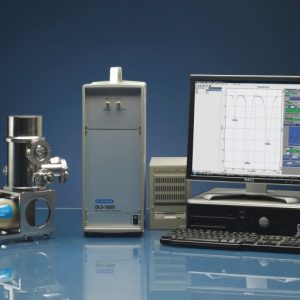
DLS-1000
The DLS-1000 is an improved, high sensitivity system. It is eight times more sensitive than its predecessor, the DLS-83D.
The system offers a fully automatic measurement mode, as well as provides complete interpretation of the measured data, including impurity identification and concentration determination without any need for user interaction.
The Deep Level Transient Spectroscopy (DLTS) is the best technique for monitoring and characterizing deep levels caused by intentionally or unintentionally introduced impurities and defects in semiconductor materials and complete devices.

DLS-1000
The DLS-1000 is an improved, high sensitivity system. It is eight times more sensitive than its predecessor, the DLS-83D.
The system offers a fully automatic measurement mode, as well as provides complete interpretation of the measured data, including impurity identification and concentration determination without any need for user interaction.
The Deep Level Transient Spectroscopy (DLTS) is the best technique for monitoring and characterizing deep levels caused by intentionally or unintentionally introduced impurities and defects in semiconductor materials and complete devices.
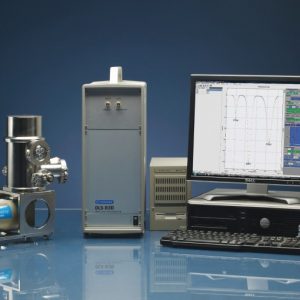
DLS-83D
The DLS-83D offers a fully automatic measurement mode, as well as provides complete interpretation of the measured data, including impurity identification and concentration determination without any need for user interaction.
The Deep Level Transient Spectroscopy (DLTS) is the best technique for monitoring and characterizing deep levels caused by intentionally or unintentionally introduced impurities and defects in semiconductor materials and complete devices. It is an extremely versatile method for determining all parameters associated with deep traps, including energy level, capturing cross-section and concentration distribution. It allows the identification of the impurities, and is capable of detecting contamination concentrations below 109 atoms/cm3.
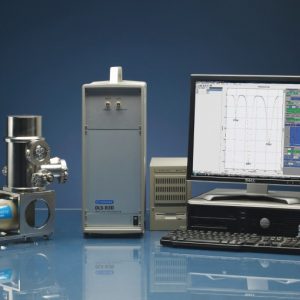
DLS-83D
The DLS-83D offers a fully automatic measurement mode, as well as provides complete interpretation of the measured data, including impurity identification and concentration determination without any need for user interaction.
The Deep Level Transient Spectroscopy (DLTS) is the best technique for monitoring and characterizing deep levels caused by intentionally or unintentionally introduced impurities and defects in semiconductor materials and complete devices. It is an extremely versatile method for determining all parameters associated with deep traps, including energy level, capturing cross-section and concentration distribution. It allows the identification of the impurities, and is capable of detecting contamination concentrations below 109 atoms/cm3.
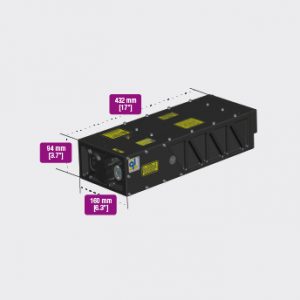
DRL (100-700 mJ)
The DRL laser is a lamp pumped Nd:YAG laser based on
2 YAG rods pumped by 1 flash lamp each. This design enables a broad range of pulse energy and repetition rate combinations. Two versions of power supplies are used to cover the whole range of repetition rates. The DRL covers
20 – 200 Hz with pulse energies of 700 – 100 mJ at 1064 nm. The laser head is compact for easy integration and sealed to operate in various environments.
- 1064, 532 and 355 nm available
- Quick umbilical disconnects
- Compact
- Multimode resonators
- 100 million shots lamp lifetime guaranteed
- Sealed laser head to operate in various environments

DROPimage Advanced
DROPimage Advanced measures contact angle, surface energy, surface and interfacial tension, advancing and receding contact angle, surface dilatational elasticity and viscosity and is particularly well-suited for time-dependent and dynamic studies.

DROPimage CA
DROPimage CA is our entry-level software solution. This program ships standard with our Model 190 CA Goniometer and can be later upgraded to DROPimage Standard or Advanced if your requirements become more demanding. The two primary tools in DROPimage CA are the Contact Angle Tool and the Calibration Command as outlined below. Additional menus are available for: options, saving and opening images, data export, video setup, zooming, and baseline setup. DROPimage CA uses the same algorithms, video control, and methodology employed in the more advanced versions of DROPimage, but lacks the surface energy and surface tension tools.

DROPimage Standard
DROPimage Standard ships with the Standard Goniometer (Model 200) and the Contact Angle Goniometer with Wafer Support (Model 400). It is also available as an upgrade for users of DROPimage CA. DROPimage Standard is well suited for contact angle and surface energy studies.
Below is a link to a playlist of videos that illustrates how easy it is to calibrate the instrument and take contact angle measurements using DROPimage Standard.
